Cutting Through Spiritual Materialism
CLEAR SPACE
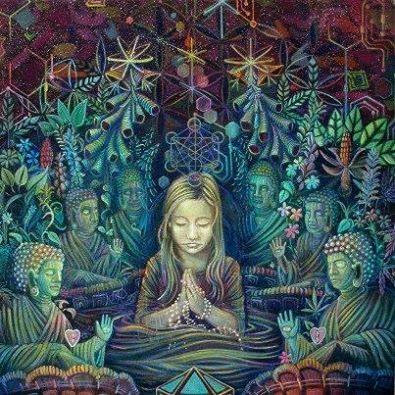
it is useful to begin with a more tangible object to calm and refine one's awareness. Breath awareness can be perfect for this. We should cultivate a general awareness of the breath coming in and going out. During inhalation, we should simply be aware that this is taking place. During exhalation, we note that the breath is going out. Awareness is allowed to rest calmly in the present, while we breathe in a natural, unforced way.
An interesting metaphor used in Tibetan Buddhism to describe the functioning of ego is that of the "Three Lords of Materialism": the "Lord of Form," the "Lord of Speech," and the "Lord of Mind." In the discussion of the Three Lords which follows, the words "materialism" and "neurotic" refer to the action of ego. The Lord of Form refers to the neurotic pursuit of physical comfort, security and pleasure. Our highly organized and technological society reflects our preoccupation with manipulating physical surroundings so as to shield ourselves from the irritations of the raw, rugged, unpredictable aspects of life. Push-button elevators, pre-packaged meat, air conditioning, flush toilets, private funerals, retirement plans, mass, production, weather satellites, bulldozers, fluorescent lighting, nine-to-five jobs, television - all are attempts to create a manageable, safe, predictable, pleasurable world. The Lord of Form does not signify the physically rich and secure life-situations we create per se. Rather it refers to the neurotic preoccupation that drives us to create them, to try to control nature. It is ego's ambition to secure and entertain itself, trying to avoid all irritation. So we cling to our pleasures and possessions, we fear change or force change, we try to create a nest or playground. The Lord of Speech refers to the use of intellect in relating to our world. We adopt sets of categories which serve as handles, as ways of managing phenomena. The most fully developed products of this tendency are ideologies, the systems of ideas that rationalize, justify and sanctify our lives. Nationalism, communism, existentialism Christianity, Buddhism - all provide us with identities, rules of action, and interpretations of how and why things happen as they do. Again, the use of intellect is not in itself the Lord of Speech. The Lord of Speech refers to the inclination on the part of ego to interpret anything that is threatening or irritating in such a way as to neutralize the threat or turn it into something "positive" from the ego's point of view. The Lord of Speech refers to the use of concepts as filters to screen us from a direct perception of what is. The concepts are taken too seriously; they are used as tools to solidify our world and ourselves. If a world of nameable things exists, then "I" as one of the nameable things exists as well. We wish not to leave any room for threatening doubt, uncertainty or confusion. The Lord of Mind refers to the effort of consciousness to maintain awareness of itself. The Lord of Mind rules when we use spiritual and psychological disciplines as the means of maintaining our self-consciousness, of holding onto our sense of self. Drugs, yoga, prayer, meditation, trances, various psychotherapies - all can be used in this way. Ego is able to convert everything to its own use, even spirituality. For example, if you have learned of a particularly beneficial meditation technique of spiritual practice, then ego's attitude is, first to regard it as an object of fascination and, second to examine it. Finally, since ego is seeming solid and cannot really absorb anything, it can only mimic. Thus ego tries to examine and imitate the practice of meditation and the meditative way of life. When we have learned all the tricks and answers of the spiritual game, we automatically try to imitate spirituality, since real involvement would require the complete elimination of ego, and actually the last thing we want to do is to give up the ego completely. However, we cannot experience that which we are trying to imitate; we can only find some area within the bounds of ego that seems to be the same thing. Ego translates everything in terms of its own state of health, its own inherent qualities. It feels a sense of great accomplishment and excitement at have been able to create such a pattern. At last it has created a tangible accomplishment, a confirmation of its own individuality. If we become successful at maintaining our self-consciousness through spiritual techniques, then genuine spiritual development is highly unlikely. Our mental habits become so strong as to be hard to penetrate. We may even go so far as to achieve the totally demonic state of complete "Egohood." Even though the Lord of Mind is the most powerful in subverting spirituality, still the other two Lords can also rule the spiritual practice. Retreat to nature, isolation, simple, quiet, high people - all can be ways of shielding oneself from irritation, all can be expressions of the Lord of Form. Or perhaps religion may provide us with a rationalization for creating a secure nest, a simple but comfortable home, for acquiring an amiable mate, and a stable, easy job. The Lord of Speech is involved in spiritual practice as well. In following a spiritual path we may substitute a new religious ideology for our former beliefs, but continue to use it in the old neurotic way. Regardless of how sublime our ideas may be, if we take them too seriously and use them to maintain our ego, we are still being ruled by the Lord of Speech. Most of us, if we examine our actions, would probably agree that we are ruled by one or more of the Three Lords. "But," we might ask, "so what? This is simply a description of the human condition. Yes, we know that our technology cannot shield us from war, crime, illness, economic insecurity, laborious work, old age and death; nor can our ideologies shield us from doubt, uncertainty, confusion and disorientation; nor can our therapies protect us from the dissolution of the high states of consciousness that we may temporarily achieve and the disillusionment and anguish that follow. But what else are we to do? The Three Lords seem too powerful to overthrow, and we don't know what to replace them with." The Buddha, troubled by these questions, examined the process by which the Three Lords rule. He questioned why our minds follow them and whether there is another way. He discovered that the Three Lords seduce us by creating a fundamental myth: that we are solid beings. But ultimately the myth is false, a huge hoax, a gigantic fraud, and it is the root of our suffering. In order to make this discover he had to break through very elaborate defenses erected by the Three Lords to prevent their subjects from discovering the fundamental deception which is the source of their power. We cannot in any way free ourselves from the domination of the Three Lords unless we too cut through, layer by layer, the elaborate defenses of these Lords. The Lords' defenses are created out of the material of our minds. This material of mind is used by the Lords in such a way as to maintain the basic myth of solidity. In order to see for ourselves how this process works we must examine our own experience. "But how," we might ask, "are we to conduct the examination? What method or tool are we to use?" The method that the Buddha discovered is meditation. He discovered that struggling to find answers did not work. It was only when there were gaps in his struggle that insights came to him. He began to realize that there was a sane, awake quality within him which manifested itself only in the absence of struggle. So the practice of meditation involves "letting be." There have been a number of misconceptions regarding meditation. Some people regard it as a trancelike state of mind. Others think of it in terms of training, in the sense of mental gymnastics. But meditation is neither of these, although it does involve dealing with neurotic states of mind. The neurotic state of mind is not difficult or impossible to deal with. It has energy, speed and a certain pattern. The practice of meditation involves letting be - trying to go with the patter, trying to go with the energy and the speed. In this way we learn how to deal with these factors, how to relate with them, not in the sense of causing them to mature in the way we would like, but in the sense of knowing them for what they are and working with their pattern. There is a story regarding the Buddha which recounts how he once gave teaching to a famous sitar player who wanted to study meditation. The musician asked, "Should I control my mind or should I completely let go?" The Buddha answered, "Since you are a great musician, tell me how you would tune the strings of your instrument. " The musician said, "I would make them not too tight and not too loose." "Likewise," said the Buddha, "in you meditation practice you should not impose anything too forcefully on your mind, nor should you let it wander." That is the teaching of letting the mind be in a very open way, of feeling the flow of energy without trying to subdue it and without letting it get out of control, of going with the energy pattern of the mind. This is meditation practice. Such practice is necessary generally because our thinking pattern, our conceptualized way of conducting our life in the world, is either too manipulative, imposing itself upon the world, or else runs completely wild and uncontrolled. Therefore, our meditation practice must begin with ego's outermost layer, the discursive thoughts which continually run through our minds, our mental gossip. The Lords use discursive thought as their first line of defense, as the pawns in their effort to deceive us. The more we generate thoughts, the busier we are mentally and the more convinced we are of our existence. So the Lords are constantly trying to activate these thoughts, trying to create a constant overlapping of thoughts so that nothing can be seen beyond them. In true meditation there is no ambition to stir up thoughts, nor is there an ambition to suppress them. They are just allowed to occur spontaneously and become an expression of basic sanity. They become the expression of the precision and the clarity of the awakened state of mind. If the strategy of continually creating overlapping thoughts is penetrated, then the Lords stir up emotions to distract us. The exciting, colorful, dramatic quality of the emotions captures our attention as if we were watching an absorbing film show. In the practice of meditation we neither encourage emotions nor repress them. By seeing them clearly, by allowing them to be as they are, we no longer permit them to serve as a means of entertaining or distracting us. Thus they become the inexhaustible energy which fulfills egoless action. In the absence of thoughts and emotions the Lords bring up a still more powerful weapon, concepts. Labeling phenomena creates a feeling of a solid definite world of "things." Such a solid world reassures us that we are a solid, continuous thing as well. The world exists, therefore I, the perceiver of the world, exist. Meditation involves seeing the transparency of concepts, so that labeling no longer serves as a way of solidifying our world and our image of self. Labeling becomes simply the act of discrimination. The Lords have still further defense mechanisms, but it would be too complicated to discuss them in this context. By the examination of his own thoughts, emotions, concepts and the other activities of mind, the Buddha discovered that there is no need to struggle to prove our existence, that we need not be subject to the rule of the Three Lords of Materialism. There is no need to struggle to be free; the absence of struggle is in itself freedom. This egoless state is the attainment of Buddhahood. The process of transforming the material of mind from expressions of ego's ambition in to expressions of basic sanity and enlightenment through the practice of meditation - this might be said to be the


 Posts
Posts


0 comments:
Post a Comment